
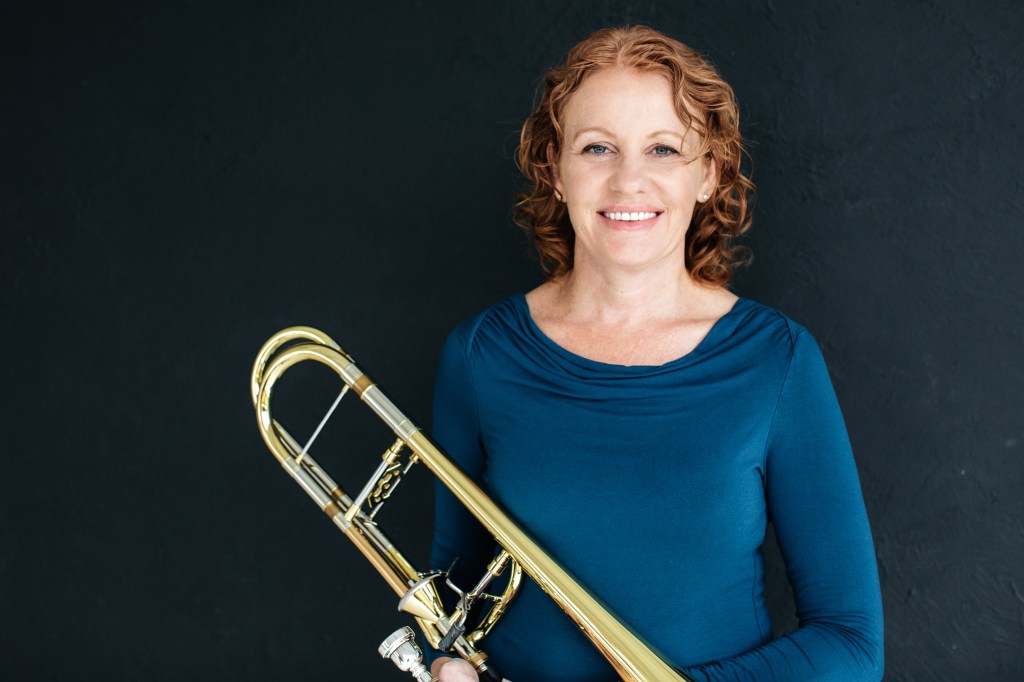
In 2023, I still encounter trombonists who resist the idea of diversity. As the Chair of the ITA’s Diversity Council, I’ve heard various forms of criticism: “leave it alone,” “everything is fine the way it is,” “what about a database of male composers?” or “if the music was any good, we’d know about it already.” To me, these statements in themselves demonstrate the need for diversity. For those who haven’t walked in the shoes of someone in a marginalized demographic, I’ll explain with some personal experiences.
Being a female trombonist has always made me different. I never hated that, in fact when I was younger, I loved being unique. I loved being underestimated: I lived for the surprised look on an adjudicator’s face. The juxtaposition of the way I looked and the way I played was an advantage in some arenas. I was aware that being a freakishly skinny girl was a novelty in the trombone world. There were a few women players I had heard of when I was younger: Ava Ordman, Abbie Conant, Heather Buchman, Debbie Taylor, Jeannie Little, Becky Cherrian, and Vivian Lee, to name a few. I was lucky to have a great woman band director in grades 5-12 and a supportive college professor in Dennis Smith at Michigan. My challenges with men came mostly in the form of older conductors and teachers. My youth orchestra director had another boy in the section double all my solos for one concert, and more than a couple teachers said something about my looks, including one that tried grooming me (almost every female trombonist I know has a similar story). The number of times I’ve heard “how does a pretty little girl get such a big sound on that trombone?” is cringe-worthy. Most of the comments we all learn to shrug off and react with a nervous smile. This was the 80s – an age where we learned to not react to inappropriate comments and lewd behavior. It was easier just to play along.
I can’t say there was a pivotal moment for me that changed my fondness for “being different.” It was more of a sudden awakening to the stream of microaggressions over the years. When I started my master’s degree at Juilliard, a goal I obsessed over, I was proud, nervous, and excited to really work hard. A fellow student mentioned to me in passing, “how does it feel to be the first female trombone student at Juillard?” Until he asked that, it never occurred to me to think of myself that way. Even if it wasn’t true, I suddenly felt like a circus act. In this corner, the odds-defying female trombonist! Everywhere I went after that felt like a test of my worth and talent. Years later, they would call this imposter syndrome, but there was no such term at the time—I just felt alone. Every performance became a matter of proving myself and my gender. If I missed a note or didn’t play aggressively enough, I would be proving stereotypes about women. As if being at Juilliard wasn’t intimidating enough, I sealed myself off in a room for one. I pushed myself so hard that I had to have surgery to remove an inclusion of scar tissue in my upper lip. I had little balance. I pushed and practiced. The surgery could have been a wakeup call, but I was so determined to not show any weakness in my recovery my second year that I walled myself off even more. My fellow trombonists at Juilliard were some of the kindest and most interesting people I’ve known. They didn’t do this to me—I did this to myself. Society’s gender stereotypes did this to me. By the time I graduated, I wanted to quit. I was burned out.
For a while, I still went through the motions and practiced, took auditions, talked myself out of deserving to win them, taught private lessons, drove all over New Jersey for gigs while working administrative jobs to pay the bills. It took two years to recover from the burnout, surgery, and be ready for any feelings of ambition again. Luckily, I met a great group of people in the summer faculty of Blue Lake Fine Arts Camp who loved their careers in college teaching. My ambition for a career in music re-emerged, and I was lucky enough to win a job with the U.S. Navy Band in D.C., a position I had for over nine years. Most importantly, this job was a catalyst for my involvement with the International Women’s Brass Conference, to which many military band members belong. It was because of the supportive network of this organization that I finally began to believe in myself again. Feeling alone is not a recipe for success. We all desire a feeling of belonging. I cannot imagine being a woman brass player without the supportive family of this organization, nor can I imagine that female composers of the past have felt the security of a similar support network.
When I transitioned to a full-time teaching career at Towson University in Baltimore, I was excited to finally have full creative control over the music I performed and the students I mentored. It was freeing and felt like a world of possibilities. Sick of playing the standard conservatory repertoire, I asked a couple of friends who were interested in composing to write me a piece. It was the first time I was a part of that process and made the performances so much more meaningful. Around the same time, a friend reached out and asked if I knew any pieces written by women composers. Embarrassingly, I did not. Even more embarrassingly, I hadn’t even thought about it. After beating myself up for a few minutes, I made up my mind to learn more and started searching the internet. It was slow going at first; there really wasn’t much out there using search engines. A friend in Michigan recommended a piece called “Ages,” written by Susan Mutter, and I knew Augusta Read Thomas and Ellen Taaffe Zwillich had written tough concerti. At first, I kept the short list on my phone. I would write down every woman composer I came across and either looked through their website catalog or contacted them personally to see if they had written anything for trombone. A year later, my list grew long enough to be worthy of a file on my computer.
This brings the story to 2012, a year we aren’t very proud of in the trombone community. The International Trombone Festival was held in France, and thanks to the outcry led by trombonist, Abbie Conant, the demographic statistics of the event were outlandish enough to enrage a lot of us and caused a friend of hers to publish an article about it in the Huffington Post: 42 men soloists featured as guest artists, 0 women; 7 male composers featured, 0 women. This was certainly a wakeup call to our community, or at least to the part of our community that wasn’t already aware this mattered. We’ve seen a lot of great change in both the ITF and ITA since then, along with a unified mission of improving diversity.
There are still events and competitions happening in 2023 that aren’t sharing these values. We have an obligation as organizers to program conferences with everyone in mind, not just our good friends that look like us. Classical music is a subjective art form with many historical and national styles. Do we all agree on the best composer, best player, best orchestral section, best piece? No, because we are all formed differently, born in different places, with different lived experiences. That’s the beauty of music. What speaks to one person may not speak to another. The more voices we have, the more people we may inspire. If I were a little girl in the audience of a trombone conference, would I feel like I belonged? Not only should we be programming our conferences with diversity in mind, but we should highlight and celebrate new voices. This is the way forward for classical music if we want to keep appealing to new audiences and filling concert seats.
This brings me to the reason for this database. It’s not enough that we check a box, which many people do by including one piece by a marginalized composer in a program. Inviting a woman artist to judge a competition along with seven men isn’t representation (not to mention the competitions that show a picture of the piano accompanist because she’s the only female – that doesn’t fool anyone). We need to purposely think diversity until everyone present feels a sense of belonging and until the concept of tokenism is dead. This takes more than just paying lip service. This means deliberate action despite the backlash by fans of the status quo and by the harmful rhetoric of activists who think that their way of fighting for diversity is the only way. This means intentional diversity programming at events, in the leadership of our organizations, in our recitals, in our teaching studios, and in our orchestras. Societal dynamics have helped a bit in recent years. Thanks to many trombonists rallying behind social justice causes, intentional programming did improve. I hate to say that in the past year or two, however, there is a downward trend in diverse programming, especially for female composers. Have we exhausted all the pieces written for trombone by women? Not even close. There are more being written every day, and still some wonderful historical pieces that no one has recorded. I’ll be using this blog to feature composers, recordings, and hopefully bring more awareness to these works. Not because I think we should avoid performing what has been known as the standard repertoire, but to keep uplifting new voices until they are considered just as standard. This effort, of course, extends beyond women, so I’ll try to highlight other programming resources here as well. I look forward to your comments!
 Trombone Compositions by Women Composers
Leave a comment